
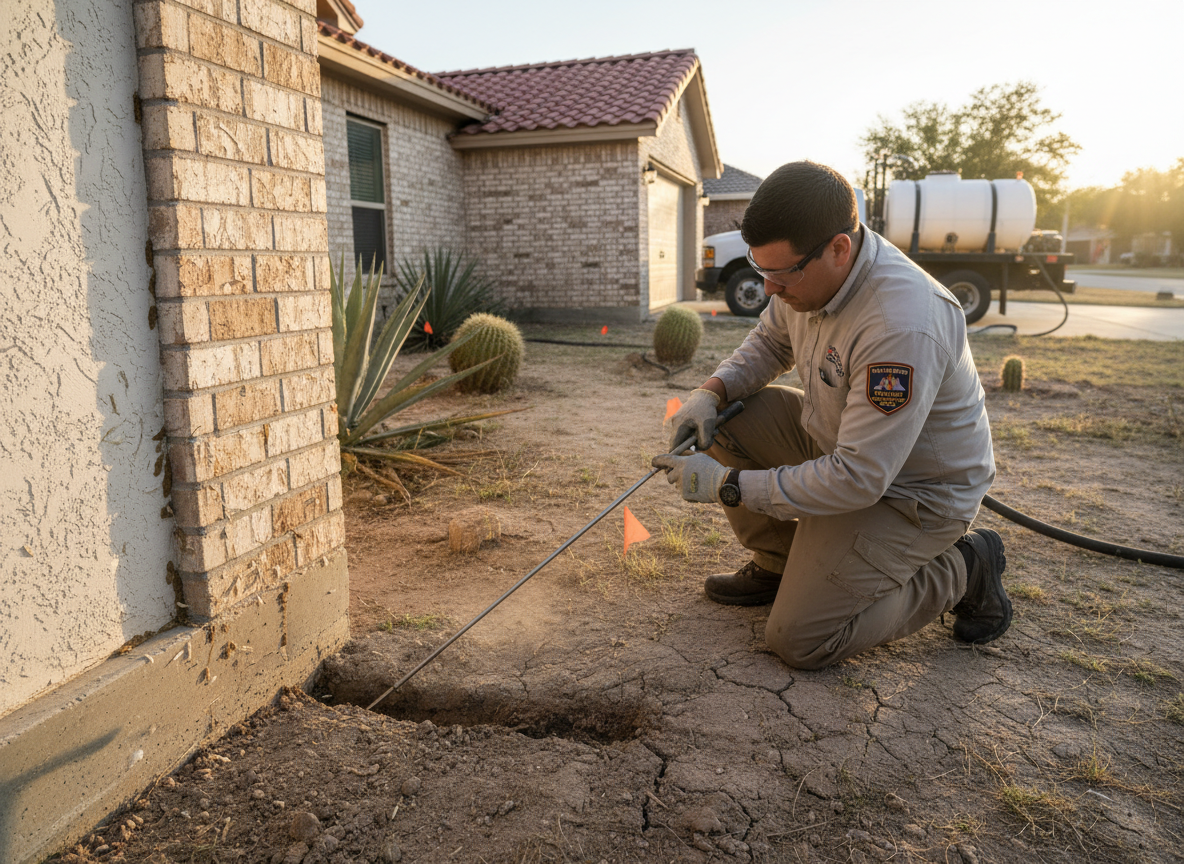
San Antonio 78254 sits on clay-rich soils that swell during spring rains and shrink in summer heat, opening gaps along slab edges and expansion joints. These movement cracks give subterranean termites direct access to the soil-to-wood transition at the foundation. Homes built from the 1970s onward in this zip code commonly use monolithic slabs with limited expansion cuts, so termites often follow utility penetrations or settle under patios poured later. Liquid termiticides must be applied in a continuous zone beneath the slab lip and along the exterior grade beam to interrupt foraging tunnels before they reach sill plates.
Foundation work here differs from crawl-space jobs because most 78254 properties lack accessible under-floor space. Technicians drill through the exterior slab edge or use rodding to reach the soil beneath the footing without disturbing finished flooring. Moisture from irrigation systems near the foundation keeps soil humidity high year-round, accelerating termite activity even in mild winters. Bait stations placed at 10-foot intervals along the perimeter allow ongoing monitoring, but they work only when the initial liquid barrier has already cut off the main colony access points created by soil settlement.
Homeowners in this area often discover damage after noticing small mud tubes climbing the stucco or brick veneer right at grade level. Once tubes appear, the treatment window narrows because termites have already reached the framing. Proper work requires trenching or drilling to label-treated soil zones that meet Texas structural pest control standards for slab construction, followed by a 30-day reinspection to confirm no new activity along the same foundation line.
Technician insight
In San Antonio 78254 the clay soils expand and contract so much after a wet spring that fresh gaps open under the slab edge every couple of years, letting termites reach the framing before homeowners notice anything on the interior.
Slab-edge termites on a 78254 street
Mud tubes appeared along the front foundation after heavy spring rain. Inspection showed termites traveling under a settled patio slab along utility lines. We trenched the exposed perimeter, rodded beneath the blocked section, and installed bait stations at the corners. Follow-up confirmed no new activity along the same footing line.
Termites Around Foundation Services We Offer
✓Slab Edge Liquid Treatment
Applies termiticide in a continuous treated zone along the exterior foundation perimeter and under the slab lip to block termite entry points created by soil movement.
✓Foundation Drilling and Rodding
Drills through the slab edge or rods beneath footings to deliver termiticide directly to the soil under the home where termites travel along utility lines.
✓Perimeter Bait Station Installation
Places monitoring and bait stations every ten feet around the foundation to detect and eliminate colonies that bypass initial liquid barriers.
✓Expansion Joint and Utility Seal
Treats and seals cracks at expansion joints and pipe penetrations where termites commonly follow moisture trails into the structure.
✓Post-Construction Soil Barrier Refresh
Reapplies termiticide along settled soil lines after heavy rains or irrigation changes have diluted earlier treatments around the foundation.
Termites Around Foundation Cost in San Antonio 78254, TX
| Service | Typical Range | What Affects It |
|---|---|---|
| Perimeter Liquid Barrier | $450–$950 | Varies with home size and number of expansion joints needing treatment |
| Foundation Drilling Add-On | $200–$450 | Added when slab edge access is blocked by patios or settled soil |
| Bait Station System | $300–$600 | Initial install plus first-year monitoring; annual renewals lower |
| Reinspection Visit | $75–$150 | Included once after initial treatment; extra visits billed separately |
Ranges are typical for San Antonio 78254, TX and confirmed with an exact written quote before any work starts.
How it works
- 1
Site Inspection
Walk the entire foundation perimeter, check for mud tubes, probe soil moisture at grade, and map utility entry points on the 78254 property.
- 2
Trenching Or Drilling
Create a treated zone by trenching along the exterior or drilling through the slab edge to reach soil beneath the footing.
- 3
Termiticide Application
Apply labeled product in a continuous barrier that meets local soil and slab conditions without runoff into irrigation zones.
- 4
Bait Station Placement
Install monitoring stations at regular intervals and record initial readings for follow-up visits.
- 5
Reinspection
Return after 30 days to verify no new activity along the same foundation sections and adjust stations as needed.
Pricing
Cost depends on linear footage of foundation, soil conditions, and whether drilling is required.