
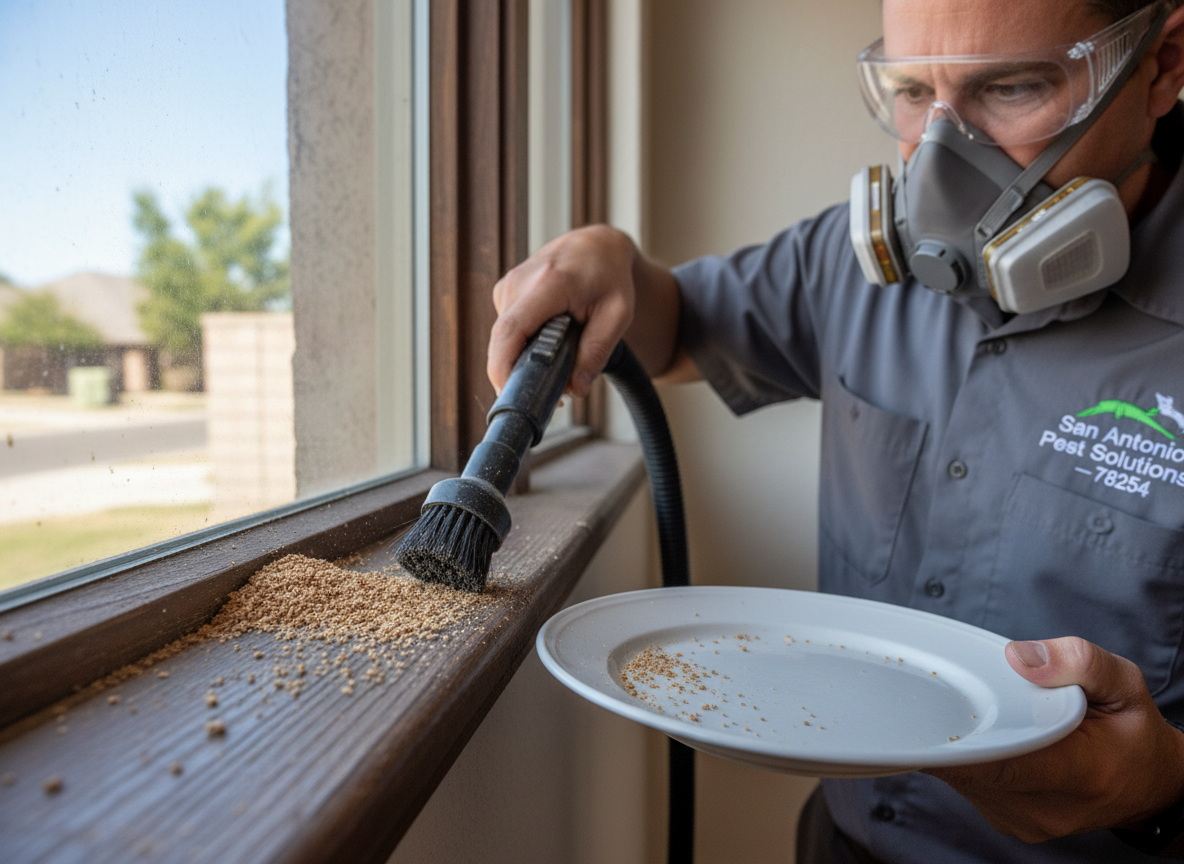
San Antonio 78254 sits on clay-heavy soil that holds moisture after spring rains, pushing subterranean termites to push mud tubes along slab edges while drywood colonies drop frass through small exit holes in attics. Homes built in the 1980s and 1990s along streets like Honiley often have limited crawl access, so frass collects behind insulation or in wall voids where standard visual checks miss it. Technicians carry fine-mesh sieves and magnification loupes on every call to separate termite pellets from carpenter ant debris or rodent droppings.
Dry summers in the 78254 ZIP force drywood termites to concentrate in roof decking and fascia, leaving cone-shaped frass piles on top plates that homeowners mistake for sawdust. When rain finally arrives, those piles absorb water and stain drywall ceilings, turning a small colony into a larger repair job. Edge cases include frass inside hollow-core doors or behind baseboards in single-story ranch homes common throughout the area.
Treatment plans combine targeted dust applications in void spaces with follow-up vacuum extraction to remove all visible frass, then a 90-day monitoring period using bait stations placed at soil grade around the perimeter. Local code requires any structural wood repair to meet current IRC standards, so crews document frass locations with photos before any wood is touched.
Technician insight
In San Antonio 78254, the thing that catches most people out with Termite Droppings and Frass is how 1980s slab homes along streets like Honiley trap drywood pellets behind blown-in insulation where summer heat drives colonies upward, and a quick sweep with a shop vac just hides the evidence until the next rain.
Attic Frass Discovery in 78254 Ranch
Homeowner noticed small brown pellets on the garage floor after a July storm. Inspection found drywood exit holes in roof decking above the master bedroom. Crew applied dust into the void, extracted all visible frass, and set perimeter monitors; no new pellets appeared during the 90-day check.
Termite Droppings and Frass Services We Offer
✓Drywood Termite Frass Removal
Targeted extraction of frass pellets from attics and wall voids in 78254 slab homes to confirm active drywood colonies.
✓Subterranean Mud Tube Inspection
Detailed tracing of mud tubes along foundations and expansion joints typical in clay-soil neighborhoods around Honiley Street.
✓Frass Sample Lab Analysis
Microscopic identification of frass to distinguish termite pellets from ant or beetle waste before treatment begins.
✓Attic Frass Cleanup
Vacuum and HEPA filtration removal of accumulated frass in 1980s-era attics where insulation hides pellet piles.
✓Foundation Perimeter Frass Monitoring
Installation of discreet monitors around slab edges to catch new frass deposits before colonies expand.
Termite Droppings and Frass Cost in San Antonio 78254, TX
| Service | Typical Range | What Affects It |
|---|---|---|
| Frass Inspection and Species ID | $175–$325 | Depends on attic access and number of samples needed |
| Drywood Frass Removal and Dust | $350–$650 | Larger attics or multiple colonies increase scope |
| Foundation Mud Tube Treatment | $250–$450 | Perimeter length and soil condition affect labor |
| 90-Day Monitoring Package | $125–$200 | Includes two follow-up visits |
Ranges are typical for San Antonio 78254, TX and confirmed with an exact written quote before any work starts.
How it works
- 1
Initial Site Walk
Technician examines exterior grade, slab edges, and attic access points in the 78254 property for fresh frass piles and mud tubes.
- 2
Sample Collection
Small frass samples are taken from multiple locations and examined on site with magnification to confirm termite species.
- 3
Targeted Treatment
Dust or bait is applied directly into active voids while avoiding finished surfaces common in local ranch homes.
- 4
Cleanup and Monitoring Setup
All visible frass is removed and stations are placed for 90-day follow-up checks.
Pricing
Most 78254 jobs fall in the mid-range because slab access and attic insulation add time but rarely require major demolition.